At a glance
| Microphone Type | Condenser USB |
|---|---|
| Polar Pattern | Cardioid |
| Sample Rate | Up to 96 kHz |
| Headphone Monitoring | Headphone output with Blend |
| Mute Button | No |
| Connection | Micro-USB |
- Model HypeMiC
- Released 2019
ApogeeLast updated on November 2026
Apogee HypeMiC Review
Prices, shipping and returns are handled by the retailer.
On this page
Overview
Recording podcasts or auditions on the move from a phone or laptop? The Apogee HypeMiC is a cardioid condenser USB microphone with a built-in analogue compressor offering three presets, 24-bit / 96 kHz conversion, 130 dB maximum SPL, a headphone output with Blend control and cables for USB-C, USB-A and Lightning.
- Analogue compressor evens out levels
- 24-bit / 96 kHz conversion
- Very small and light at 200 g
- Works with iPhone, iPad, Mac and PC
Key Takeaways
- Three compression presets
- 46 dB maximum preamp gain
- Tripod, pop filter and case included
Best For
- Voice actors
- Mobile podcasters
- Travelling presenters
Avoid If
- You record in a noisy room
- You want a mic that stays on a boom arm
Pros & Cons
The HypeMiC is a premium travel mic with a genuinely useful compressor and high-resolution conversion. It needs a quiet room, and at full price it is a specialist tool rather than a general meeting mic.
PROS
- Analogue compressor evens out levels
- 24-bit / 96 kHz conversion
- Very small and light at 200 g
- Works with iPhone, iPad, Mac and PC
CONS
- Condenser picks up room sound
- Micro-USB port on the mic
- Expensive at full price
Review Scores
Score Breakdown
8.4/10 Expert Score
- Capsule Quality & Fidelity8.8/10
- Interface Versatility & Patterns7.7/10
- On-Mic Hardware Controls8.0/10
- DSP Engine & Software7.4/10
- Mounting & Shock10.0/10
How this score is calculated
Each criterion is the weighted average of its available spec scores (0–10), calculated from official specifications using our Microphones scoring matrix. Empty specs are skipped, not scored as 0. The Expert Score is the weighted average of the scored criteria, shown out of 10; stars = Expert Score ÷ 2 (a 9.4/10 score is 4.7 stars), to one decimal.
| Criterion | Weight | From specs | Score |
|---|---|---|---|
| Capsule Quality & FidelityTransducer Type: Condenser → 7.5; Sample Rate: Up to 96 kHz → 9.5; Bit Depth: 24-bit → 9.5; Self-Noise: -108 dBFS (A) at 0 dB gain → 10.0; Max SPL: 130 dB (1% THD at 1 kHz) → 8.5 | 40% | 8.8 | 8.8 |
| Interface Versatility & PatternsConnection: Micro-USB → 10.0; XLR Output: No → 4.0; Polar Pattern: Cardioid → 9.0; Number of Patterns: 1 → 6.0 | 20% | 7.7 | 7.7 |
| On-Mic Hardware ControlsGain Control: Yes (dial, up to 46 dB) → 10.0; Zero-Latency Monitoring: Yes → 10.0; Touch Mute: No → 3.0; Headphone Monitoring: Headphone output with Blend → 8.0 | 15% | 8.0 | 8.0 |
| DSP Engine & SoftwareOnboard DSP: Analogue compressor with three presets → 7.0; Software / DSP: MetaRecorder → 8.0 | 15% | 7.4 | 7.4 |
| Mounting & ShockStand / Mount: Desktop tripod (included) → 10.0; Pop Filter / Windscreen: Yes (included) → 10.0 | 10% | 10.0 | 10.0 |
| Expert Score | 8.4/10 | ||
Apogee HypeMiC Review
Apogee is a Los Angeles digital audio company best known for studio converters and interfaces. The HypeMiC followed its earlier MiC models in 2019, adding an analogue compressor. In 2025 Gearnews reported a four-mic HypeMiC podcast kit built around it.
Capsule Quality & Fidelity 8.8/10
Apogee lists 24-bit / 96 kHz conversion, a maximum SPL of 130 dB, -36 dBFS sensitivity and up to 46 dB of preamp gain. The cardioid condenser capsule is tuned for voice and acoustic instruments.
Voices sound clean, close and detailed, with a finished quality that usually needs processing afterwards. That makes recordings sound ready for an audition or podcast straight from the mic.
Compared with the Rode NT-USB+, it is far smaller, but in a quiet room the two are closer in sound quality than the size difference suggests.
- Element Condenser
- Sample Rate Up to 96 kHz
- Bit Depth 24-bit
- Noise -108 dBFS (A) at 0 dB gain
Interface Versatility & Patterns 7.7/10
The cardioid capsule captures mainly from the front of the mic. As a condenser, it still hears room reflections and distant noise more than a dynamic.
In a bare office or near traffic, background sound becomes noticeable on calls.
The compressor raises quiet passages, which can also lift room tone between sentences, so lighter settings suit meetings better than the heaviest preset.
The mic uses a micro-USB port, with cables for USB-C, USB-A and Lightning included. It works with macOS, Windows and iOS, drawing power from the connected device.
That cable kit means you can record directly into an iPhone or iPad without extra adapters, which few USB mics support so well. There is no XLR output.
The micro-USB connector is dated, and a lost cable is harder to replace than a USB-C one, so keep the originals in the case.
- Connect Micro-USB
- XLR No
- Pattern Cardioid
- Patterns 1
On-Mic Hardware Controls 8.0/10
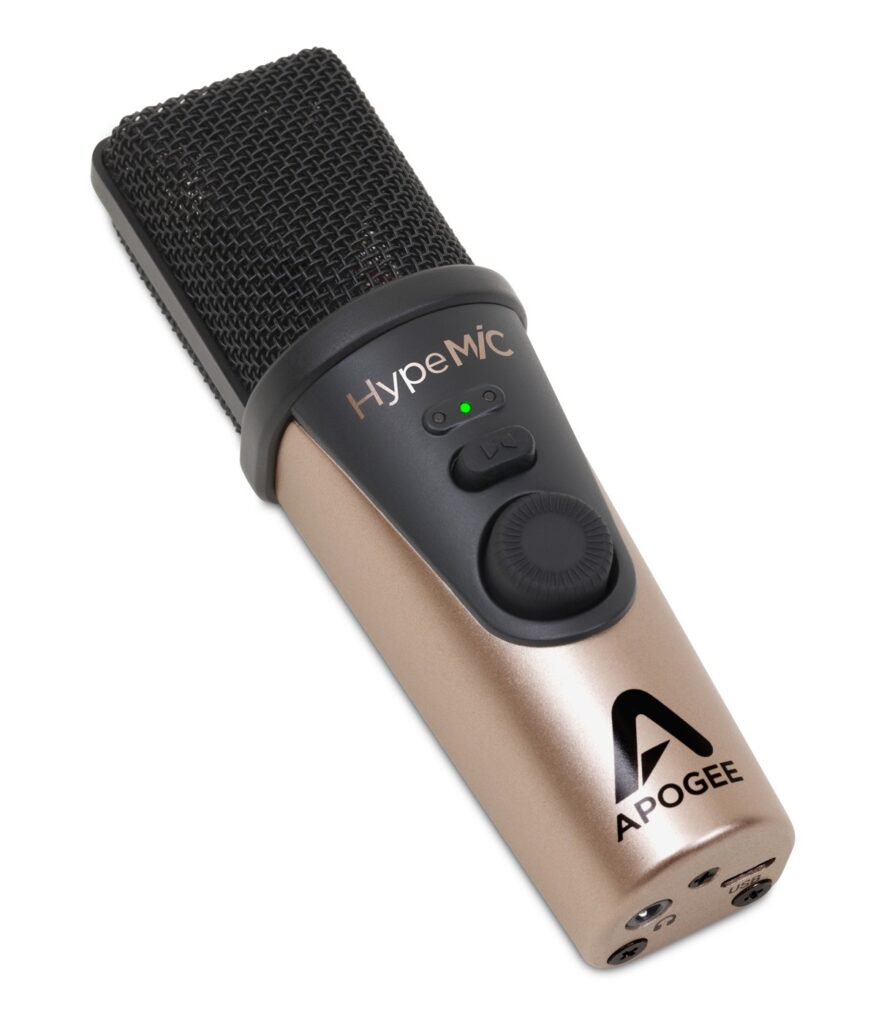
A dial on the front sets gain or headphone level, and a soft key cycles three Blend positions between direct mic signal and computer playback. A separate button cycles the three compressor presets.
Blend lets you hear yourself with no delay while also hearing a director or remote guest, a practical feature for voice actors recording live sessions.
There is no dedicated mute button, so meeting users will need to mute in the app. Colour LEDs show connection status and the selected setting.
- Gain Yes (dial, up to 46 dB)
- Zero Lat. Yes
- Monitor Headphone output with Blend
DSP Engine & Software 7.4/10
The HypeMiC uses MetaRecorder (optional; also works with any audio app) for its companion software. Onboard DSP is listed as Analogue compressor with three presets.
The software or onboard controls also include EQ or presets (3 analog compressor settings), monitoring (Headphone output with Blend), gain control (dial, up to 46 dB) and a mix control (Blend, three positions). Official capture is listed at up to 96 kHz and 24-bit.
Mounting & Shock 10.0/10
HypeMiC measures 124 x 38 x 38 mm and weighs 200 g. It ships with a desktop tripod, a mic stand adapter, a pop filter and a carry case.
The metal body and included case make it easy to carry in a laptop bag. The small tripod puts it at desk height, though not quite at mouth level when you sit upright.
The stand adapter lets it mount on a regular mic stand when you have a fixed studio position.
- Stand Desktop tripod (included)
- Pop Filter Yes (included)
Full Specifications
General
| Best For | Travelling voice actors and mobile podcasters |
|---|---|
| Release Year | 2019 |
| Launch Price | $349 |
| Use Case | Voice-over, podcasts, mobile recording |
| Weight | 200 g |
| Dimensions | 124 x 38 x 38 mm |
| In the Box | Mic, tripod, stand adapter, pop filter, case, three cables |
| Warranty | 1 year |
| Model Number | HypeMiC |
Capsule Quality & Fidelity 8.8/10
| Transducer Type | Condenser |
|---|---|
| Sample Rate | Up to 96 kHz |
| Bit Depth | 24-bit |
| Self-Noise | -108 dBFS (A) at 0 dB gain |
| Max SPL | 130 dB (1% THD at 1 kHz) |
| Sensitivity | -36 dBFS (94 dB SPL, 1 kHz) |
| Microphone Type | Condenser USB |
| Capsule Size | Condenser |
Interface Versatility & Patterns 7.7/10
| Connection | Micro-USB |
|---|---|
| XLR Output | No |
| Polar Pattern | Cardioid |
| Number of Patterns | 1 |
| USB Connector | Micro-USB |
| Cable | Micro-USB to USB-C, USB-A and Lightning |
| Phantom Power | No (USB bus powered) |
| Wireless | No (wired USB) |
| Phone / Tablet Support | Yes (iPhone and iPad) |
| OS Compatibility | macOS, Windows, iOS |
On-Mic Hardware Controls 8.0/10
| Gain Control | Yes (dial, up to 46 dB) |
|---|---|
| Zero-Latency Monitoring | Yes |
| Headphone Monitoring | Headphone output with Blend |
| Mix Control | Yes (Blend, three positions) |
| Lighting | Yes (3 status / level / blend LEDs) |
| Mute Button | No |
DSP Engine & Software 7.4/10
| Onboard DSP | Analogue compressor with three presets |
|---|---|
| Software / DSP | MetaRecorder (optional; also works with any audio app) |
| Presets / EQ | Yes (3 analog compressor settings) |
Mounting & Shock 10.0/10
| Stand / Mount | Desktop tripod (included) |
|---|---|
| Pop Filter / Windscreen | Yes (included) |
| Boom Arm Compatible | Yes (microphone stand adapter included) |
Product Details
| Brand | Apogee |
|---|---|
| Model | HypeMiC |
| Model number | HypeMiC |
| Release year | 2019 |
Price Comparison
| Store | Price | Deal |
|---|---|---|
| Apogeedigital.comOfficial Apogee store | Launch price $349 | View deal (opens in a new tab) |
The Verdict
Buy the Apogee HypeMiC if you record auditions or podcasts on the move from a phone or laptop.
Skip it if you record in a noisy room. For a fixed desk where meetings come first, the Shure MV7+ is a better everyday mic.
Our assessment is based on Apogee’s product listing and technical data. See How We Score for how the Expert Score weighs each criterion.
FAQs
What makes the HypeMiC different?
It has a built-in analogue compressor with three presets.
What resolution does it record?
Up to 24-bit / 96 kHz.
Does it work with an iPhone?
Yes, a Lightning cable is included and it also works over USB-C.
Is there a mute button?
No, use your app’s mute.
How heavy is it?
200 g.
What comes in the box?
A tripod, stand adapter, pop filter, case and three cables.
Does it have XLR?
No.
Is it good for noisy rooms?
It works best in quiet spaces, as it is a condenser.